

Covid-19 & the sharemarket
The week ending Friday 13th March 2020 will go down in history as one of the most volatile weeks in sharemarket history. The Australian sharemarket (as defined by the S&P/ASX All Ordinaries index) finished down more than 11% and global sharemarkets (as defined by MSCI World index) finished down more than 12%. Even Friday…

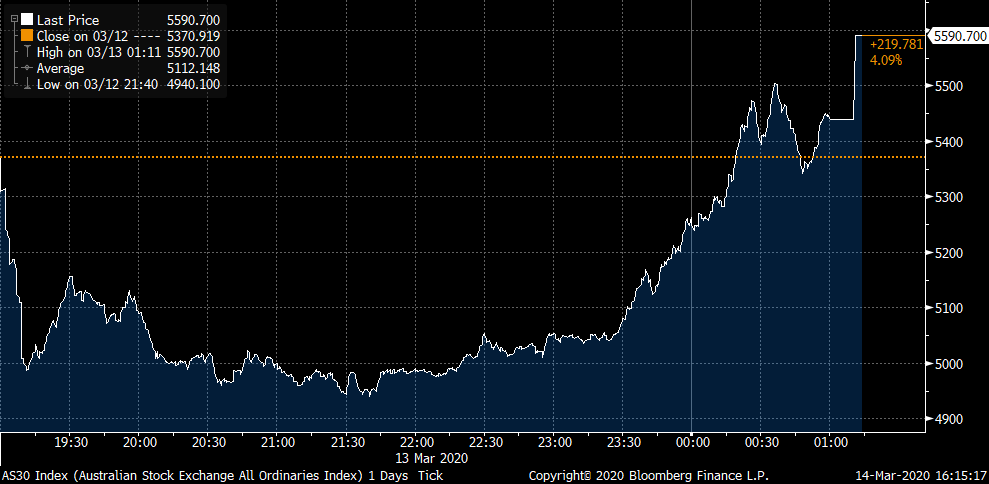
The week ending Friday 13th March 2020 will go down in history as one of the most volatile weeks in sharemarket history. The Australian sharemarket (as defined by the S&P/ASX All Ordinaries index) finished down more than 11% and global sharemarkets (as defined by MSCI World index) finished down more than 12%. Even Friday the 13th saw incredible volatility in the Australian sharemarket (See Chart 1) started the day down almost 8% before a 12% turnaround to end the day up 4.4%.
Chart 1 – S&P/ASX All Ordinaries Index – Price Movement 13 March 2020
Source: Bloomberg
From sharemarket highs around 19/20 February, both the Australian sharemarket (S&P/ASX All Ordinaries index) and Global sharemarkets have fallen by almost 23%. A painful result for many.
It doesn’t take a genius to work out this market behaviour is due to the global economic impacts caused by the spread of the coronavirus, COVID-19. This virus has resulted in empty sporting stadiums around the world, travel bans, major event cancellations, universities and school closures, job losses (e.g. Flight Centre), and the list goes on. The global economy is highly likely to shrink in the March 2020 quarter and many companies will be reporting lower than originally expected revenues and profits than previously anticipated. Weaker company earnings is why the sharemarket is down.
Whilst we do not know how widespread the virus will be nor how long COVID-19 will impact the economy and markets, what we do know about financial markets is:
- Cash and Government Bond yields both in Australia and around the world are at or near record lows meaning their future returns are likely to be very low also.
- Valuations of sharemarkets (using metrics like Price/Book or PE Ratio) are the lowest they’ve been for around 12 to 15 months … but this is not without risk
As COVID-19 continues to spread around the world it is very likely that all markets will continue to be volatile. But for those investors with surplus cash, this may present buying opportunities that may serve well for the long-term (i.e. 5 or more years).
So, for investors that are currently fully invested, trying to market time in and out of the sharemarket is not recommended. Time out of the market often results in unnecessary losses and a long-term approach is usually best.
But for those investors with excess cash, this may be an opportunity to see your financial adviser to ensure your investments are aligned to meet your objectives and reach your financial goals.
Published:
Share


Resources
A wealth of knowledge
Latest News
-
New Year, New Money Habits: What to Stop Doing in 2026
 January 27, 2026
-
What a Financial Plan Actually Looks Like
January 20, 2026
-
Realistic Budgeting Tips for Australians in 2026
January 20, 2026
-
Economic Snapshot – December 2025 Update
January 20, 2026
-
Why a Financial Health Check in January Matters
January 13, 2026
-
The Cost of Living Isn’t Going Down – Here’s How to Stay Ahead
January 13, 2026

Tools & Guides
Useful tools & guides to get you started
 Find out more

Video Guides
Useful videos to get you started
Find out more

Financial Calculators
See what impact little changes can have
Find out more